
Newport NK180 HD vs. NK300 HD Review: Which Kayak Motor Should You Buy?
In this Newport NK180 HD vs NK300 HD comparison, the short answer is that both motors are excellent. The right one for you comes down to your kayak size and how much weight you're willing to carry for extra speed.

Newport NK180 HD vs NK300 HD: Quick Verdict
NEWPORT
NK180 HD

OVERALL SCORE
8.3 / 10
$1,299.00
Best for: Small to mid-size kayaks, lightweight throw-and-go setups, anglers who want to run lighter
Not ideal for: Anglers prioritizing top speed over efficiency, big tournament rigs
NEWPORT
NK300 HD
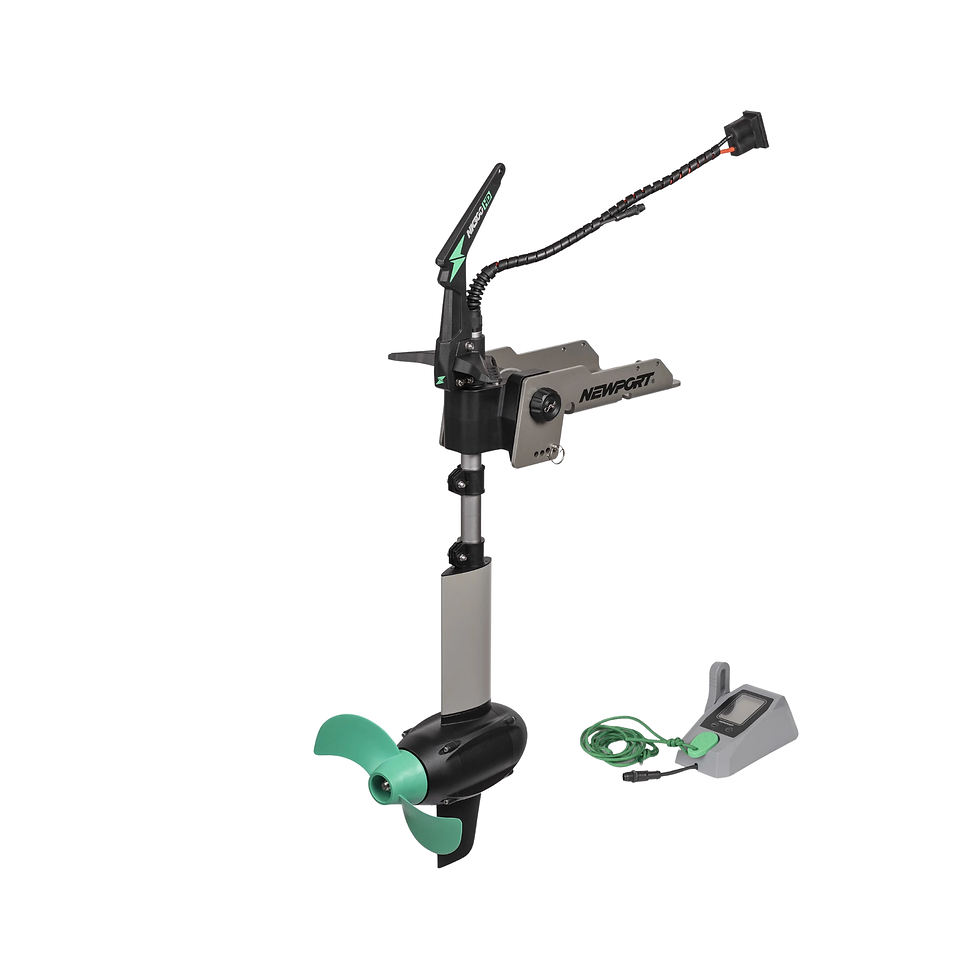
OVERALL SCORE
8.2 / 10
$1,499.00
Best for: Bigger kayaks, tournament rigs, anglers who want to cover water fast and don't mind the extra weight
Not ideal for: Smaller or lighter kayaks that don't need the extra power
Score Breakdown
NEWPORT
NK180 HD
Design: 8.3
Performance: 8.6
Durability: 8.5
Value: 7.9
OVERALL SCORE
8.3 / 10
NEWPORT
NK300 HD
Design: 8.3
Performance: 8.6
Durability: 8.5
Value: 7.5
OVERALL SCORE
8.2 / 10
Why We Tested These Together
If you fish out of a kayak long enough, you eventually want a motor. Newport's NK180 HD and NK300 HD are the two options most anglers land on, and the question we get asked most isn't "are these any good," it's "which one do I actually need." We've run both motors hard for a full season, so instead of two separate reviews that make you cross-reference specs yourself, here's the head-to-head.
How We Tested
We ran the NK180 HD and NK300 HD heavily, all year, on lakes and rivers. Both motors have seen multiple tournaments across multiple states, several battery brands and sizes, and conditions ranging from open water to grass, rock, and shallow water where you're most likely to hit something.
Specs
Spec | NK180 HD | NK300 HD |
|---|---|---|
Price | $1,299 | $1,499 |
Power | 1.8 HP (600W) | 3 HP (1300W) |
Top speed | Up to 6 mph | Up to 6.5 mph |
Max run time | 37.5 hours | 30 hours |
Max range | 100 miles | 66 miles |
Weight | ~14 lbs | 25.5 lbs |
Battery | 24V (Newport LoPro or any 24V) | 36V (Newport LoPro or any 36V) |
Drive | Brushless | Brushless |
Foil | Not included | Pre-installed |
Saltwater ready | Yes | Yes |
Mount | Standard 4-bolt pattern | Standard 4-bolt pattern |
Key Features
Battery Flexibility
The standout feature on both motors is that you're not locked into Newport's proprietary battery. As long as you match the voltage (24V for the 180, 36V for the 300), you can run whatever battery fits your kayak's layout and your budget. Brands that force you onto their own battery line typically cost more and give you less control over where the weight sits in your boat.
Brushless Drive and Conformal Coating
Both motors use a brushless drive system and conformal-coated electronics, which matters most if you fish saltwater or spend a lot of time in grass and shallow, silty water. It's the kind of feature that doesn't show up in a spec sheet skim but shows up in a five-year ownership timeline.
Mounting and Steering
Both motors mount to any standard 4-bolt pattern in the stern, with foot-pedal steering run via cable, either along the deck or through the hull. Setup mechanics are identical across both models.
Performance
NK180 HD
Light at just over 14 lbs, and the 24V battery draw keeps the whole setup economical. We're regularly seeing 4.5 to 5.5 mph on most kayaks, and a 50Ah 24V battery will comfortably cover a 6 to 8 hour fishing day. It doesn't ship with a foil or rock guard, so budget for Newport's add-on attachments if you're running skinny water. This is the motor for smaller to mid-size kayaks, rivers, and mid-sized lakes.
NK300 HD
This is the speed and power option. We're seeing 5.5 to 6.5 mph on most kayaks, even larger ones like the NuCanoe UMax. The tradeoff is size and weight, 25.5 lbs plus a heavier, pricier 36V battery. Efficiency is close to the 180's, but you're paying for the extra mph and the ability to move a bigger boat. If you're running a mid-size or larger kayak, this is the motor.
Both motors are quiet enough to fish still water without spooking fish, and both are saltwater ready.
Installation and Ease of Use
Installation is straightforward on both. Bolt the mounting plate to the kayak, slide the motor into the collar, mount the collar to the plate. Most anglers finish the full install in 1 to 2 hours. The main snag is on kayaks without pre-installed steering tubing, you'll either need to install your own or run the foot steering cable above deck. Neither motor's throttle controller ships with a threaded track-mount option, so plan on Newport's flush mount plate or YakAttack's controller mount and, separately, YakAttack's Throttle Mount ($52) if you want the throttle on a track.
Pros and Cons
Shared
Pros:
Powerful for the class
Easy to install
Runs on any battery at the correct voltage, not locked to a proprietary line
Quiet
Cons:
Throttle controller isn't threaded for track mounting out of the box
Cotter pins are small and easy to lose, keep spares on hand
Multiple cables to manage: foot steering, retraction, reverse
NK180 HD Specific
Pro: Noticeably lighter, easier to load and unload solo
Con: Lower top speed if you regularly cover long distances
NK300 HD Specific
Pro: Pre-installed foil, ready for rougher conditions out of the box
Con: Heavier motor plus a heavier, more expensive 36V battery
Price and Value
At $1,299 and $1,499, neither motor is cheap. Value is the lowest-scoring category for both, 7.9 for the NK180 HD and 7.5 for the NK300 HD, and that gap is the story. 36V batteries typically run 30 to 50% more than 24V batteries, so the NK300 HD's real cost gap over the NK180 HD is larger than the $200 sticker difference once you factor in the battery. If your kayak and use case genuinely call for the extra power, that gap is worth paying. If you're on the fence, the NK180 HD gets you nearly the same efficiency for less money up front and less ongoing battery cost, which is exactly why it scores higher on value.
How These Compare to the Rest of the Market
NK300 HD vs. Torqeedo Travel Ultralight
Spec | NK300 HD | Torqeedo Travel Ultralight |
|---|---|---|
Price | $1,499 (any 36V battery, sold separately) | $1,799 motor only, $3,398 with Torqeedo's required battery |
Power | 3 HP (1300W) | 1100W (3 HP-equivalent, direct drive) |
Battery | 36V, works with Newport's LoPro or any third-party 36V battery | Proprietary 1080Wh Li-ion only, no third-party batteries supported |
Weight (motor, no battery) | 25.5 lbs | 21.6 lbs including mount, cables, and throttle |
Weight (with battery) | Varies by battery chosen | ~40.6 lbs total (18.4 kg) |
Steering | Includes full foot-pedal steering cable kit | Connects to your kayak's existing foot-control rudder, must already have one |
Warranty | See Newport's standard terms | 24 months |
The Torqeedo is a genuinely well-built motor, and its direct-drive system has a following for a reason. But being locked to Torqeedo's own battery is the deciding factor for most kayak anglers. A full Travel Ultralight setup with battery runs $3,398, more than double the NK300 HD before you've even bought a battery for it. Unless you specifically want the direct-drive feel or you're already in the Torqeedo ecosystem, the NK300 HD's battery flexibility makes it the better value for most tournament and big-water setups.
NK180 HD vs. ePropulsion kLite 750
Spec | NK180 HD | ePropulsion kLite 750 |
|---|---|---|
Price | $1,299 (any 24V battery, sold separately) | $1,599 |
Power | 1.8 HP (600W) | 500W continuous, 750W Sport Burst (60 seconds) |
Battery | 24V, works with Newport's LoPro or any third-party 24V battery | Integrated 378Wh battery built into the motor housing, not swappable, optional range-extension accessory available |
Total weight | ~14 lbs motor only, battery weight on top of that | ~14.3 lbs total including battery |
Max range | 100 miles (rated) | 11+ miles tested on Fish Mode |
Min operating depth | Not specified for shallow-draft use | As little as ~7 inches, built for skinny water |
Steering | Full foot-pedal steering cable kit included | Rudder-shaped housing plus low-profile throttle, mounts to 4-bolt stern and track systems |
This is a closer call than the NK300 HD comparison. The kLite 750 is purpose-built for kayaks specifically, and its integrated battery means no separate battery box or wiring to manage, which is genuinely appealing for a grab-and-go setup. Its tradeoff is range, 11 miles tested versus the NK180 HD's 100-mile rating, and a battery you can't swap out or upsize later. If you fish short, skinny-water sessions and want the simplest possible setup, the kLite 750 is worth a look. If you fish all day or want the option to run a bigger battery down the road, the NK180 HD's flexibility wins.
Who Should Buy Which
Get the NK180 HD if:
You're running a small to mid-size kayak
You want the lightest setup possible
You mostly fish rivers or mid-sized lakes
You want to keep battery cost down
Get the NK300 HD if:
You're running a bigger kayak or a tournament rig
Covering water quickly matters more than saving weight
You want the pre-installed foil for rougher conditions
Bottom Line
The NK180 HD scores 8.3 out of 10, the NK300 HD scores 8.2, and both earn it. Newport's NK180 HD and NK300 HD remain the gold standard for kayak motors, reliable, efficient, and easy to live with, and both hold up well against purpose-built alternatives like the Torqeedo Travel Ultralight and the ePropulsion kLite 750. The NK180 HD is the smarter buy for smaller boats and lighter setups. The NK300 HD is the one to get if you need speed and power and don't mind the extra weight. Match the motor to your kayak, not the other way around.
FAQ
How fast is the Newport NK300 HD?
Up to 6.5 mph, with most kayaks seeing 5.5 to 6.5 mph in real-world testing.
How fast is the Newport NK180 HD?
Rated up to 6 mph, with most kayaks seeing 4.5 to 5.5 mph.
What battery do the NK180 HD and NK300 HD use?
The NK180 HD runs on 24V, the NK300 HD runs on 36V. Both accept Newport's LoPro battery or any third-party battery that matches the required voltage.
Is the NK300 HD worth the extra $200 over the NK180 HD?
Only if your kayak and use case call for the extra speed and power. Factor in that the 300's 36V battery also costs more than the 180's 24V battery, so the real price gap is bigger than $200.
Are these motors saltwater safe?
Yes, both are saltwater ready.
Where to Buy
NK180 HD: Buy the Newport NK180 HD
NK300 HD: Buy the Newport NK300 HD
Comments